logo
Good price  online

products details

Created with Pixso. Home Created with Pixso. Products Created with Pixso.
Sapphire Tube
Created with Pixso.

High Purity EFG Sapphire Tube with Extreme Hardness and Superior Thermal Performance

High Purity EFG Sapphire Tube with Extreme Hardness and Superior Thermal Performance

Brand Name: zmsh
Model Number: EFG tube
MOQ: 1pcs
Price: by case
Packaging Details: custom cartons
Payment Terms: T/T
Detail Information
Place of Origin:
China
Supply Ability:
by case
Highlight:

High Purity Sapphire Tube

,

Extreme Hardness EFG Sapphire Tube

,

Superior Thermal Performance Al₂O₃ Tube

Product Description
EFG Sapphire Tube Edge-Defined Film-Fed Growth
Overview

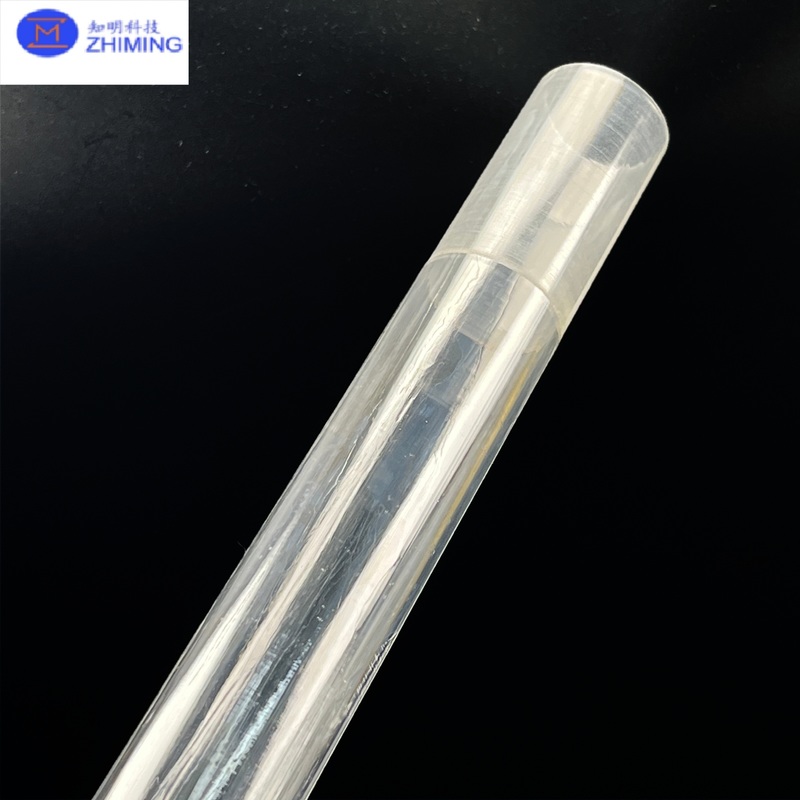
EFG sapphire tubes are high-performance components made from single-crystal aluminum oxide (Al₂O₃) using the Edge-Defined Film-Fed Growth (EFG) method. This advanced crystal growth technique allows the production of sapphire tubes with controlled dimensions, high optical clarity, and excellent mechanical strength. EFG sapphire tubes combine exceptional hardness, chemical stability, and thermal resistance, making them ideal for extreme industrial and scientific environments.

High Purity EFG Sapphire Tube with Extreme Hardness and Superior Thermal Performance 0

 
Manufacturing Principle

The EFG (Edge-Defined Film-Fed Growth) process involves drawing molten sapphire material through a precisely shaped die, where capillary action feeds the melt to the growth front. As the material crystallizes upward, it forms a continuous tube or rod according to the die's geometry.

High Purity EFG Sapphire Tube with Extreme Hardness and Superior Thermal Performance 1

This technique enables near-net-shape growth, minimizing post-processing such as grinding or polishing. Unlike traditional KY or Czochralski methods that produce bulk crystals for later machining, the EFG process allows direct formation of tubular sapphire with uniform wall thickness, high yield, and dimensional precision.

The result is a seamless single-crystal tube with excellent orientation control and minimal internal stress.

Key Features and Advantages
  • High Purity & Optical Transparency: EFG sapphire tubes exhibit over 85% optical transmission from UV to IR wavelengths (190 nm-5 μm), suitable for optical and analytical systems.
  • Extreme Hardness: With a Mohs hardness of 9, sapphire tubes resist abrasion and mechanical wear even under harsh operating conditions.
  • Superior Thermal Performance: The melting point exceeds 2000°C, and the tubes maintain strength and dimensional stability up to 1800°C in air and vacuum environments.
  • Excellent Chemical Resistance: Sapphire is inert to most acids, alkalis, and plasma atmospheres, making EFG tubes ideal for semiconductor and high-purity chemical processing.
  • Smooth Surface & Dimensional Accuracy: The EFG process ensures consistent wall thickness and smooth internal/external surfaces, reducing contamination and improving optical performance.
  • Cost Efficiency: Since the EFG method grows the final shape directly, it significantly reduces material waste and machining costs compared to other crystal fabrication methods.


EFG sapphire tube curved-surface test result

The plot shows the spectral transmittance (%T) of an EFG sapphire tube measured on a curved surface over 300–800 nm. The transmittance remains largely flat at approximately 84–86% across the entire range, indicating stable optical transmission with no obvious absorption bands or sharp dips in the visible region. This behavior suggests low bulk absorption and no strong impurity/color-center features within the measured band.

The ~85% “plateau” is consistent with uncoated sapphire, where overall transmission is often limited by Fresnel reflection losses at the air–sapphire interfaces rather than by internal absorption. A slight upward trend toward longer wavelengths can occur due to reduced short-wavelength sensitivity to scattering and interface effects.

Minor fluctuations in the curve are typical for curved-surface measurements, commonly caused by varying incidence angles, beam coupling changes, surface micro-scattering, and instrument noise. Overall, the sample demonstrates good broadband transparency in the UV–visible range tested. If higher transmittance is required, surface polishing optimization and/or anti-reflection (AR) coating are recommended.

High Purity EFG Sapphire Tube with Extreme Hardness and Superior Thermal Performance 2
 
Applications

EFG sapphire tubes are widely used in industries requiring both mechanical durability and optical transparency, such as:

  • Semiconductor Processing: Protective tubes for thermocouples, plasma reactors, and diffusion furnaces.
  • Optical Instruments: Spectroscopic cells, laser housings, and protective windows.
  • High-Temperature & Corrosive Environments: Furnace sight glasses, lamp envelopes, and thermal protection sleeves.
  • Medical and Analytical Devices: Flow cells, capillary tubes, and fiber protection channels.
  • Aerospace & Defense: Optical sensors, protective covers, and guidance system housings.
Specifications (Typical)
Property Value
Material Single-crystal Al₂O₃ (99.99%)
Growth Method EFG (Edge-Defined Film-Fed Growth)
Outer Diameter 1 mm - 80 mm (customizable)
Wall Thickness 0.2 mm - 5 mm
Length Up to 1500 mm
Orientation c-plane or a-plane
Transmission Range 190 nm - 5 μm
Working Temperature Up to 1800°C
Surface Finish As-grown or polished
FAQ
Q1: What is the difference between EFG and KY sapphire tubes?

A1: EFG sapphire tubes are grown directly into tubular shapes, allowing for thinner walls and longer lengths with minimal machining. KY sapphire tubes are cut and polished from bulk crystals, offering higher structural uniformity but at higher production costs.

Q2: Are EFG sapphire tubes suitable for optical applications?

A2: Yes. EFG tubes offer excellent transmission from UV to IR and can be used for spectroscopic and optical protection purposes.

Q3: Can EFG sapphire tubes be customized?

A3: Absolutely. Diameters, wall thickness, crystal orientation, and surface finish can all be tailored according to customer specifications.

Q4: How does EFG sapphire compare to quartz or glass?

A4: EFG sapphire offers significantly higher hardness, temperature tolerance, and chemical resistance compared to quartz or borosilicate glass, making it more durable in extreme conditions.