logo
Good price  online

products details

Created with Pixso. Home Created with Pixso. Products Created with Pixso.
Sapphire Substrate
Created with Pixso.

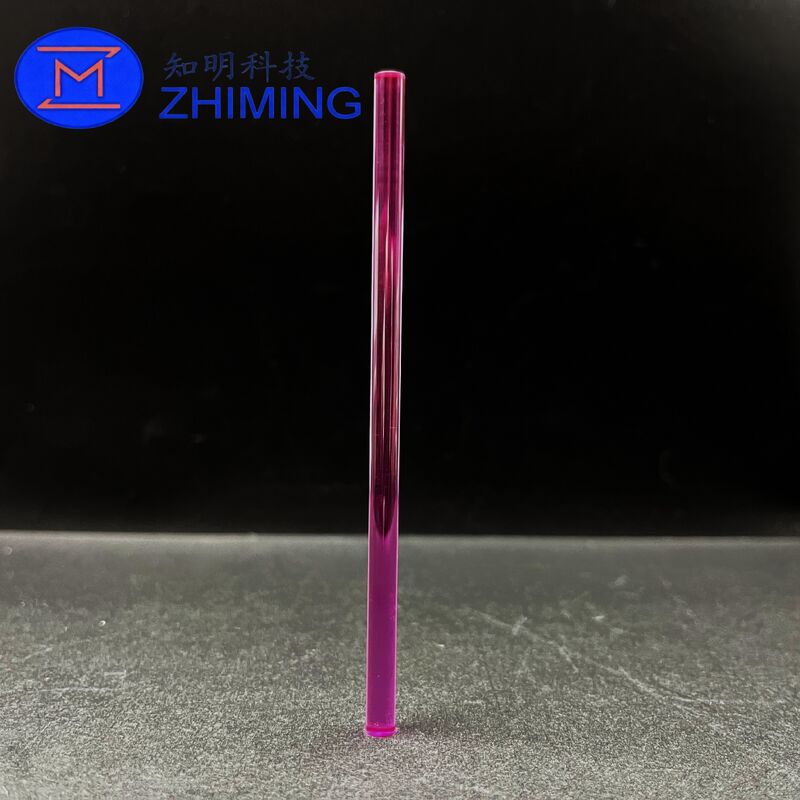
Synthetic Ruby Laser Rods (Cr:Al₂O₃) for Laser Equipment Length up to 200 mm

Synthetic Ruby Laser Rods (Cr:Al₂O₃) for Laser Equipment Length up to 200 mm

Brand Name: ZMSH
MOQ: 10
Payment Terms: T/T
Detail Information
Place of Origin:
SHANGHAI,CHINA
Material:
Synthetic Ruby (Cr:Al₂O₃)
Dopant Concentration:
0.03% – 0.05% Cr₂O₃
Crystal Structure:
Trigonal (α-Al₂O₃)
Growth Method:
Czochralski (CZ)
Laser Wavelength:
694.3 Nm (R₁ Line)
Color:
Pink To Deep Red
Diameter Range:
2 – 50 Mm
Length Range:
Up To 200 Mm
Density:
3.98 G/cm³
Hardness:
Mohs 9
Refractive Index:
~1.763 @ 694 Nm
Product Description

Synthetic Ruby Laser Rods (Cr:Al₂O₃) for Laser Equipment Length up to 200 mm


Product Overview:


Our synthetic ruby laser rods are grown using the Verneuil (Flame Fusion) method, a mature and widely adopted crystal growth process for laser-grade ruby. This method enables good crystal homogeneity, controlled chromium (Cr³⁺) dopant distribution, and reliable optical performance suitable for commercial and industrial laser applications.


Verneuil-grown ruby crystals exhibit high transparency, stable fluorescence behavior, and consistent laser output, making them a proven gain medium for pulsed ruby laser systems. Due to chromium doping and internal stress characteristics, the achievable crystal size is more limited than undoped sapphire; however, ruby rods with lengths up to 200 mm can be supplied depending on diameter and specification.


All ruby laser rods are fabricated with strict control of end-face flatness, parallelism, and perpendicularity to meet laser-grade optical requirements. Custom machining, polishing, and tolerances are available upon request.


Synthetic Ruby Laser Rods (Cr:Al₂O₃) for Laser Equipment Length up to 200 mm 0Synthetic Ruby Laser Rods (Cr:Al₂O₃) for Laser Equipment Length up to 200 mm 1


Product Features


  • Laser-Grade Synthetic Ruby
    Single-crystal Cr:Al₂O₃ grown by the Verneuil (Flame Fusion) method

  • Reliable Optical Quality
    Uniform chromium distribution and controlled defect levels for stable laser behavior

  • Stable Laser Emission
    Optimized for ruby laser emission at 694.3 nm (R₁ line)

  • High Mechanical Hardness
    Mohs hardness 9 with excellent wear and abrasion resistance

  • Thermal & Chemical Stability
    Suitable for pulsed laser operation and demanding environments

  • Precision Fabrication
    Optical-grade end faces with controlled flatness and parallelism

  • Custom Dimensions Available
    Diameter, length, orientation, and surface finish per customer drawing


Technical Specifications


Property Specification Notes
Material Synthetic Ruby (Cr:Al₂O₃) Verneuil-grown
Dopant Concentration 0.03% – 0.05% Cr₂O₃ By weight
Crystal Structure Trigonal (α-Al₂O₃) R3c
Growth Method Verneuil (Flame Fusion) Single crystal
Laser Wavelength 694.3 nm (R₁ line) Ruby laser emission
Color Pink to deep red Chromium dependent
Diameter Range 2 – 50 mm Typical
Length Range Up to 200 mm Diameter dependent
Density 3.98 g/cm³
Hardness Mohs 9 Extremely hard
Refractive Index ~1.763 @ 694 nm Ordinary ray
Fluorescence Lifetime ~3 ms At 300 K
End Face Flatness ≤ λ/4 Laser-grade
End Face Parallelism ≤ 10 arc seconds Typical
Surface Finish Fine polished / Optical polished Optional
Recommended Max Temp ≤ 200 °C Avoid thermal shock


Applications


  • Ruby Laser Equipment
    Active gain medium for pulsed ruby lasers

  • Holography
    Coherent red light sources

  • Medical Lasers
    Tattoo removal, dermatology, pigmented lesion treatment

  • Scientific Research
    Laser–matter interaction and spectroscopy studies

  • Laser Rangefinding & LIDAR
    High-energy pulsed laser sources

  • Precision Ruby Components
    Watch bearings, wear-resistant ruby parts, waterjet nozzle orifices


FAQ – Frequently Asked Questions


Q1: What crystal growth method is used for these ruby rods?
A: The ruby rods are grown using the Verneuil (Flame Fusion) method, which is the most widely used and proven technique for laser-grade synthetic ruby.


Q2: What is the maximum available length?
A: Ruby rods with lengths up to 200 mm can be supplied, depending on diameter and application requirements.


Q3: Why is Verneuil-grown ruby commonly used for laser rods?
A: The Verneuil method offers stable optical performance, acceptable defect control, and cost efficiency, making it well suited for commercial and industrial ruby laser systems.


Q4: Can custom dimensions and tolerances be provided?
A: Yes. Custom diameter, length, polishing grade, orientation, and optical tolerances can be provided based on drawings or specifications.


Q5: How should ruby laser rods be stored and handled?
A: Store in a clean, dry, light-protected environment. Avoid fingerprints, mechanical shock, and rapid thermal cycling above 200 °C.


Storage & Handling Recommendations

  • Store in clean, dry, light-protected packaging

  • Clean using methanol or other non-abrasive solvents

  • Avoid mechanical shock and excessive clamping force

  • Use compliant thermal interface materials during mounting


Related Product


Synthetic Ruby Laser Rods (Cr:Al₂O₃) for Laser Equipment Length up to 200 mm 2


Customized Ruby Laser Rods Al₂O₃:Cr³⁺ Diameter 2mm/4mm Length 10mm/20mm