| Brand Name: | ZMSH |
| MOQ: | 1 |
| Price: | by case |
| Packaging Details: | custom cartons |
| Payment Terms: | T/T |
Alumina Ceramic rods and bars are precision ceramic components manufactured from high-purity aluminum oxide (Al₂O₃). Known for their exceptional hardness, electrical insulation, wear resistance, and high-temperature stability, alumina ceramic rods are widely used in semiconductor, electronics, machinery, medical, laser, and industrial automation applications.
These ceramic bars can be produced in rectangular, square, round, or customized profiles with tight dimensional tolerances and excellent surface finish. Depending on the application requirements, alumina purity can range from 95% to 99.8% or higher.
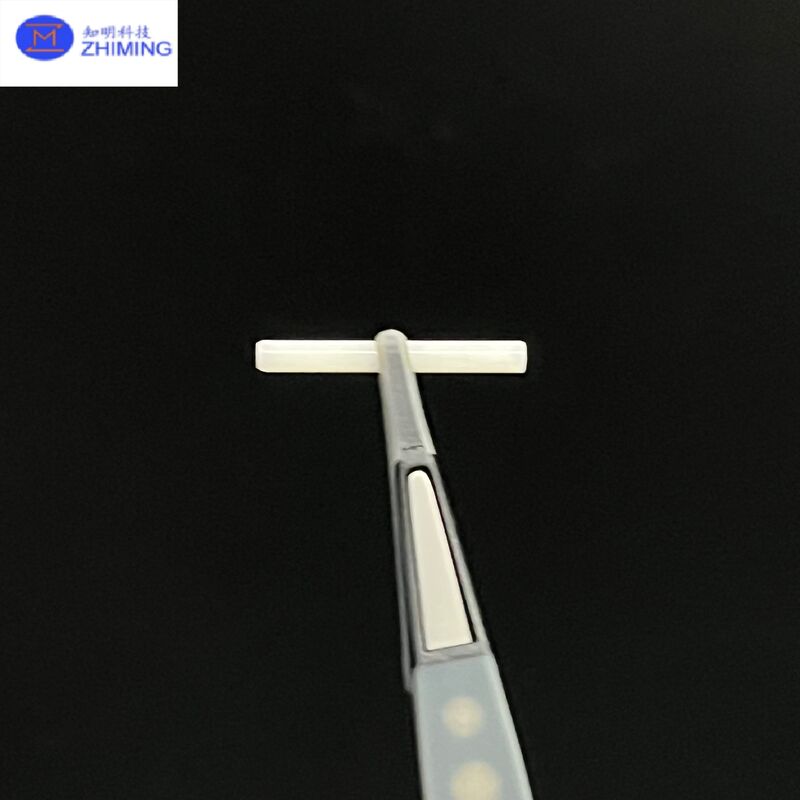
The product shown in the image is a high-precision rectangular alumina ceramic bar with excellent surface uniformity and clean edges, suitable for high-end industrial and electronic applications.
![]()
Alumina ceramics possess extremely high hardness, second only to diamond among common engineering materials. This makes ceramic rods highly resistant to abrasion, scratching, and mechanical wear.
Alumina ceramic bars provide excellent dielectric properties and are ideal for electrical insulation structures, semiconductor equipment, and high-voltage applications.
Al₂O₃ ceramic rods maintain mechanical stability and insulation performance under elevated temperatures, often exceeding 1500°C in continuous operation environments.
The material demonstrates excellent resistance to acids, alkalis, solvents, and oxidizing environments, making it suitable for harsh chemical processing systems.
Compared with metals, alumina ceramics exhibit low thermal expansion and excellent dimensional stability during temperature fluctuations.
High-purity alumina powder is selected according to application requirements, commonly including:
Additives and binders are mixed to improve forming performance.
Different shaping technologies may be used depending on the rod geometry:
For precision rectangular ceramic bars, extrusion and precision grinding are commonly adopted.
The formed green bodies are sintered at temperatures typically between 1600°C and 1800°C, creating dense ceramic structures with excellent mechanical properties.
After sintering, advanced machining processes may include:
This ensures accurate dimensions and smooth surfaces.
| Item | Specification |
|---|---|
| Material | Alumina Ceramic (Al₂O₃) |
| Purity | 95%–99.8% |
| Shape | Rectangular / Round / Square |
| Color | White / Ivory |
| Density | 3.6–3.9 g/cm³ |
| Hardness | HRA 80–90 |
| Maximum Working Temperature | 1500–1700°C |
| Surface Finish | Polished / Ground |
| Tolerance | Customizable |
| Custom Processing | Available |
Used as insulating support bars, guide rails, wafer handling components, and precision positioning parts in semiconductor manufacturing systems.
Widely applied in electronic insulation structures, circuit protection components, and sensor assemblies.
Used in wear-resistant sliding systems, precision guides, mechanical insulation parts, and automation equipment.
Suitable for high-cleanliness medical devices due to excellent chemical inertness and biocompatibility.
Can be used as insulating structural parts in laser equipment and optical alignment systems.
Applied in furnace insulation supports, heating system components, and thermal processing fixtures.
Custom alumina ceramic rods can be manufactured according to customer drawings or samples, including:
OEM and ODM services are available for industrial projects.
Common purity levels include 95%, 96%, 99%, 99.5%, and 99.9% alumina ceramics.
Yes. Customized sizes, tolerances, and shapes can be manufactured according to drawings or technical requirements.
Yes. Alumina ceramics provide excellent electrical insulation and are widely used in electronic and semiconductor industries.